Well, it’s October, so you know what that means. The quintessential fall month has arrived, and it’s about time we respond appropriately with some horror content!
I love horror novels and short stories. Today, I’m going to focus on one of my favorite horror stories: The Haunting of Hill House (not the TV series, nor the movie, nor the other movie, but indeed the book)! The Haunting of Hill House is a fantastic exercise in psychological horror – while the book is short, it packs a powerful punch and leaves a lasting impression, and it dives deeply into the inner social psychology of its protagonist. But characters aren’t what I’m here to discuss today…
While reading The Haunting of Hill House, I couldn’t help but compare the setting to that of a video game – and here’s where the strenuous comparisons begin.
A video game, specifically a horror video game, is about as opposite from a horror novel as you can get. Novels give you a barrage of information in text form and force you to construct a world in your imagination. There is no music, no art, no animation, and certainly no jump scare technique to fall back upon – rather, the author is forced to slowly build simmering tension and freak out the reader in a purely psychological (NOT reactionary) manner. The setting of The Haunting of Hill House is portrayed more in an evocative manner than a descriptive one, and many of the precise details are left to the reader’s imagination as the novel instead focuses on the general mood and tone surrounding the house.
Meanwhile, a game does everything for you. It creates the level, gives you decor and geometry, puts a soundtrack beneath your endeavors, and drops you in, allowing you to make your own direct interactions with the world.
And so, for that reason, I’m not going to talk about horror games.
Instead, I want to talk about the level design we see in certain video games, and compare it to the way an author sculpts out the “level” in our heads when reading a novel set in a haunted house.
Shirley Jackson’s Metroidvania
The comparison to a metroidvania is obvious. In The Haunting of Hill House, Shirley Jackson (the author) first takes us on a tour through the haunted house before later penning the various events which befall the cast of main characters as they backtrack throughout the imposing setting. Similarly, in a typical metroidvania, we begin by pushing forwards through an area (you can’t backtrack if there’s nothing to backtrack to!) and only double back on ourselves once we’ve fleshed out the general design of the world.
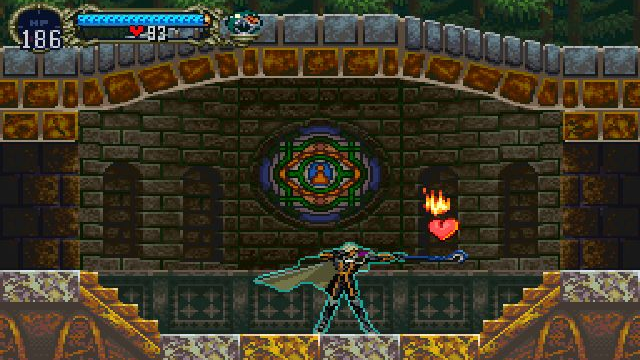
For instance, there is a well-detailed phenomenon surrounding the design of Castlevania: Symphony of the Night. Immediately after beginning the game, we start by walking to the right, as is customary in a typical linear “classicvania” game, and traverse the entire width of the map. It is only after we’ve gone to the other side that we turn back and fill in the different areas we missed.
The Haunting of Hill House reminds us WHY we do this in our metroidvanias from a pacing standpoint. Sure, we need to explore the world before we can backtrack, but Symphony of the Night nevertheless takes it to the next level, holding back on backtracking as long as possible until we literally cannot backtrack any further. We are introduced to a level as if it is a character, and get to know it on the surface level – it is only later when we can get to know the intricacies of its personality. The game gives us only a concrete linear path before later allowing itself to be opened up, a mystery slowly revealed.
Which brings me to my second point:
It’s Alive!!
Let’s pivot away from metroidvanias and turn to the level design of other games. After all, how could we discuss level design without discussing Zelda?
There’s a lot I could talk about surrounding Zelda dungeons and their design, but today, in keeping with the creepy theme, I’ll just focus on Majora’s Mask, surely the creepiest and most twisted of all the Zelda games. It only feels right!
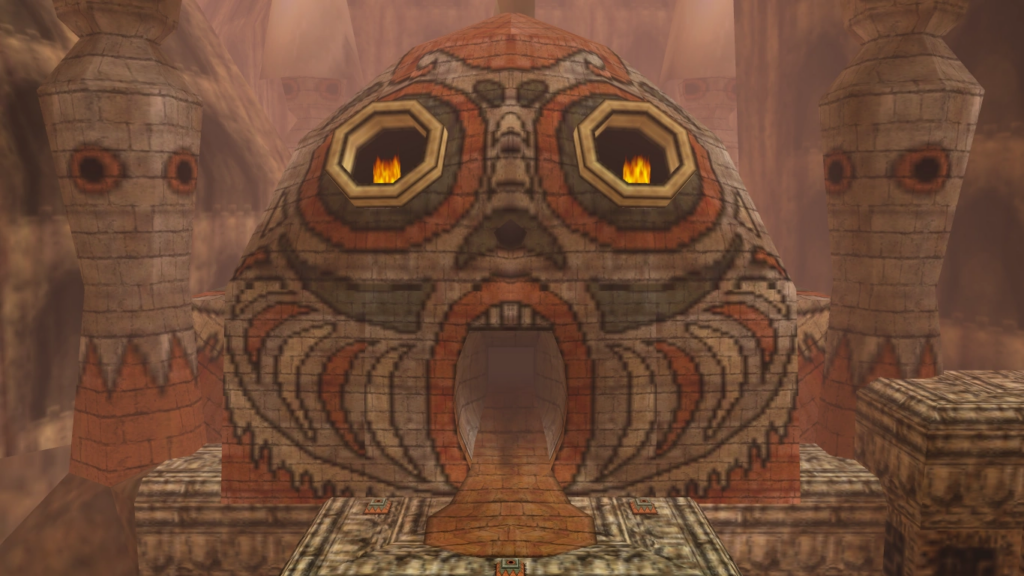
Majora’s Mask only has four dungeons, but each one, like the moon suspended above Termina or Hill House itself, feels alive. Woodfall Temple rises out of a swamp to greet us, and inside it hosts a series of spinning flowers which feel like organic mechanisms. Snowhead Temple stretches upwards and refuses to allow us through until we literally punch out its central support column. Great Bay Temple is a spinning masterpiece of whirring machinery and pipes, shooting the player through different veins and arteries and into different chambers reminiscent of organs. Finally, Stone Tower Temple greets us with an imposing face both inside and outside of the dungeon, and only yields to us after we turn the whole thing upside down as if we’re interrogating a prisoner.
By treating a level as a living, breathing space, designers are able to give their areas a unique kineticism and grant harmony between all the level’s moving parts. This seems to be one of the key aspects which truly makes video game levels stand the test of time.
I could, of course, go on and on – this really could be the topic of a full analysis essay. I haven’t talked about the living feel of Mario levels, nor the horror design in Metroid Fusion and Dread, never mind the vast majority of other Zelda dungeons which all feel alive in their own right. But I do think you get the idea, and if I were to spell out all the different living, dynamic systems across different video game levels, we’d probably be here all day.
So, to close, let me encourage you to do some things. First, check out The Haunting of Hill House if you haven’t already. It’s one of my favorite novels, and maybe you’ll find lots of other similarities with video games! Second, play cool games and think about where you see living levels, because there’s absolutely no way I’ve captured all the different ways a designer can take inspiration from living settings in games. And, finally, have a great fall! See you around!